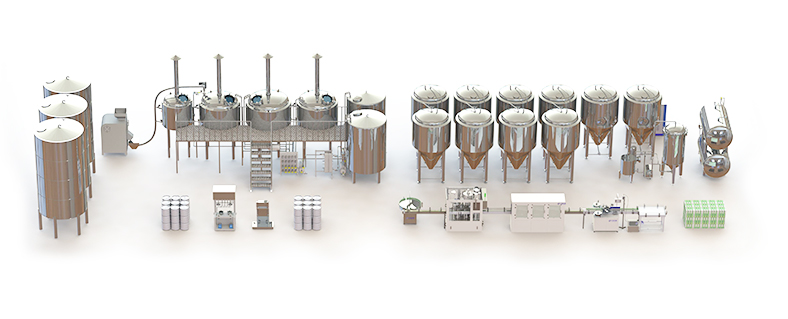
A turn-key brewery solution should match production volume, fermentation time, utilities, packaging speed, sanitation, and future tank additions rather than simply supplying a brewhouse and fermenters. A 20 BBL brewhouse running two batches per day can produce 40 BBL of wort, but cellar capacity must hold that output for 10–21 days or longer. Water use, refrigeration, steam, electrical service, CIP flow, and packaging capacity can limit production before the brewhouse does. Buyers should also check pressure-vessel compliance, 304 or 316 stainless-steel specifications, welding documentation, automation components, installation scope, spare parts, commissioning, and local service availability before comparing total project cost.
A brewery should first be sized from finished-beer output rather than the number printed on the brewhouse. A 20 BBL system brewing 8 batches per week sends about 160 BBL into fermentation before process losses. If average tank occupancy is 18 days, the cellar needs enough working volume to hold several weeks of production while allowing time for cleaning, conditioning, transfers, and scheduling changes.
That calculation becomes more useful when tank utilization is included. A nominal 20 BBL fermenter cannot normally be treated as 20 BBL of unrestricted liquid capacity because fermentation requires headspace. Depending on vessel geometry, recipe, and supplier design, usable volume and gross volume may differ by roughly 20–25%, so drawings should state both figures rather than one tank size.
A brewhouse capable of producing two batches in one shift does not create two-batch production capacity when the cellar, chiller, CIP system, or packaging line can only support one.
Fermentation time changes the equipment count quickly. An ale occupying a tank for 12–16 days requires less cellar capacity than a lager held for 25–40 days. A brewery making several beer styles should therefore model each product separately instead of applying one fermentation period across the entire annual forecast.
The same approach applies to brewhouse configuration. A two-vessel system combines several operations and usually has more scheduling limits, while three- and four-vessel layouts can separate mash, lautering, boiling, and whirlpool work. The useful measure is not vessel count but the number of consistent batches that can be completed within the planned 8-, 10-, or 12-hour production shift.
| Area to verify | Useful project figure | What should be documented |
|---|---|---|
| Fermenter sizing | 20–25% gross-volume allowance may be required | Gross and working volume |
| Cellar planning | 10–40+ days per production cycle | Tank occupancy by beer style |
| Water | Around 7:1 industry-average ratio in older BA guidance | Peak and daily consumption |
| Efficient water use | Below 3:1 achieved by some brewers | Metered process sections |
| Glycol | Often 20–25% mixture in applicable systems | Concentration and design temperature |
| Pressure equipment | Code depends on jurisdiction | Design pressure, test records, certificates |
Water deserves its own calculation because brewery consumption extends far beyond recipe water. The Brewers Association has reported an average brewery water-use ratio around 7 barrels of water for 1 barrel of beer, while more efficient operations have achieved ratios below 3:1. Cleaning, rinsing, packaging, floors, tank preparation, and utilities account for much of the difference.
A brewery targeting 10,000 BBL of annual beer output at a 7:1 ratio would use about 70,000 BBL of water before considering whether restaurant or taproom consumption is separately metered. At 3:1, the same production volume would use about 30,000 BBL. The building's incoming water line, hot-water storage, drainage, and wastewater arrangements therefore need to match peak hourly demand as well as annual averages.
Brewers Association benchmarking also separates breweries into production bands such as below 1,000 BBL, 1,000–10,000 BBL, 10,000–100,000 BBL, and above 100,000 BBL per year because efficiency varies with scale and operating pattern. Its five-year benchmarking work uses metrics such as electricity consumption per barrel to compare facilities within similar production ranges.
Refrigeration should be calculated from simultaneous cooling demand, not fermenter volume alone. Wort cooling, fermentation heat, cold crashing, bright tanks, ambient temperature, piping losses, and cold rooms may request cooling at the same time. A system sized for average demand can struggle when several tanks are brought from fermentation temperature toward near-storage temperature during the same production period.
Glycol specification also needs more detail than chiller horsepower. The Brewers Association's draught guidance, for example, notes typical glycol-water ranges of 20–25% for applicable cooling systems and recommends following the equipment manufacturer's concentration requirement. Concentration affects freeze protection and heat-transfer performance, so the supplier should state design temperature, flow, pump head, reservoir size, and expected pressure drop.
Heating deserves the same treatment. Steam systems can serve brewhouse vessels and other thermal loads, but boiler capacity, steam pressure, condensate handling, water treatment, ventilation, and local inspection requirements must be included in the facility plan. Electric systems remove several steam components but can require substantial electrical service, especially when large heating elements operate together.
Food-contact construction should then be checked vessel by vessel. The FDA's 2022 Food Code notes that beer brewers commonly use stainless steel or stainless-steel-lined equipment for piping, fermenters, filters, holding tanks, and filling equipment after hot-side brewing stages. Smooth, corrosion-resistant, cleanable surfaces reduce places where product or soil can remain after cleaning.
Buyers should request material certificates where required, internal-finish specifications, welding records, passivation procedures, jacket information, valve schedules, spray-device specifications, and pressure-test documents. 304 stainless steel is widely used in brewery fabrication, while 316 or 316L may be selected in areas where process chemistry, cleaning chemistry, or corrosion exposure justifies the added material cost.
Pressure rating cannot be assumed from tank appearance. A fermentation vessel, bright tank, or other pressurized vessel should be supplied for the operating pressure and jurisdiction where it will be installed. ASME BPVC Section VIII covers pressure-vessel construction in applicable projects, and ASME maintains separate requirements for materials, examination, welding qualifications, and overpressure protection.
The ASME Boiler and Pressure Vessel Code dates to 1914–1915 and has since developed into a broad framework for pressure-equipment design, construction, inspection, and testing. A buyer in North America should confirm whether ASME stamping, registration, local inspection, or other documentation is required before fabrication, because retroactive certification can be difficult or impractical.
Sanitation should be reviewed through the piping drawings rather than a supplier's statement that the system is "CIP ready." Pipe diameter, pump flow, spray-ball demand, return routing, drainability, valve orientation, dead-leg length, chemical concentration, temperature, and cleaning time all affect whether a vessel can be cleaned repeatedly without dismantling large sections of the system.
FDA HACCP guidance calls for sanitary equipment design, documented maintenance, calibration, cleaning procedures, and sanitation schedules. Although the exact regulatory framework depends on the facility and product, the engineering principle is useful for breweries: cleaning procedures should be designed with the equipment rather than written after installation.
A CIP skid with enough tank volume but insufficient pump flow or return capacity may extend cleaning time, leave poor spray coverage, and reduce the number of production cycles available in a 24-hour period.
Automation should also match the operating model. A 5 BBL taproom brewery may work well with manual valves and automated temperature loops, while a plant producing 50,000 BBL per year may benefit from recipe control, automated valve feedback, flowmeters, level measurement, alarm history, data logging, and repeatable transfer sequences.
Component availability matters more than the number of screens on the control panel. PLCs, VFDs, temperature transmitters, pressure sensors, actuators, and power supplies should have identifiable manufacturers and model numbers. The brewery should receive electrical schematics, PLC backups where contractually included, I/O lists, alarm descriptions, and replacement-part references instead of depending on one technician for routine service.
A supplier offering a Brewery/Distillery/Winery All-In-One Solution should also define the boundary between factory-supplied equipment and site work. Tank placement may be included while utility connections are excluded; process piping may be included while building drains are not. Freight, unloading, crane work, insulation, electrical cabling, permits, boiler installation, refrigerant work, CO₂ distribution, and commissioning should each have an assigned party.
Packaging needs equal attention because a fast brewhouse can feed a slow filling area for only so long. A canning line rated at 30 cans per minute theoretically processes 1,800 cans per hour before stoppages, changeovers, quality checks, product changes, and cleaning. Actual scheduling should use expected operating efficiency rather than the nameplate rate printed by the machine manufacturer.
Layout then ties the calculations together. Fermenters need service clearance; platforms need safe access; hoses and fixed piping need workable routes; spent grain needs an exit path; forklifts and pallet jacks need aisle width; tanks need a practical installation route through doors, roofs, or removable wall sections. A 12-foot tank cannot be treated as a 12-foot building-height requirement because fittings, lifting, platform geometry, and installation clearance consume additional space.
Expansion allowances should appear on the first utility drawings. Adding four fermenters later may require more glycol flow, electrical capacity, compressed air, CO₂ distribution, drainage, control-panel I/O, and packaging hours. Reserving 20–30% physical or utility capacity in selected areas can cost less than replacing undersized infrastructure after production has already filled the available floor space.
Commercial comparison should therefore use installed project cost rather than tank price. Freight, duties where applicable, rigging, piping, insulation, electrical work, refrigeration, steam equipment, water treatment, commissioning, spare parts, training, and local contractor hours can materially change the final number even when two equipment quotations appear similar.
Before signing, request a complete equipment list, utility schedule, general arrangement drawing, P&ID set, pressure documentation, electrical requirements, installation responsibility table, commissioning scope, warranty terms, recommended spare-parts package, and expected service response. A turn-key package should describe how the brewery will operate at its planned production rate, not only what equipment will arrive on the truck.