What a Five-Star Safety Rating Really Covers
A five-star result is a laboratory and crash-test finding, and it is worth exactly what it measures. The Australian pages describe the New G6 as backed by Euro NCAP five-star safety, which is a genuine published claim about tested performance, not a promise about the wet roundabout at the end of your street. Knowing where the rating ends is what separates a careful buyer from a reassured one, and buyers searching suv cars australia are usually after exactly that distinction.
Key takeaways
- The published safety framing for the New G6 is Euro NCAP five-star.
- XPILOT ASSIST is an assistance function, and the driver remains responsible at all times.
- The Lofic perception setup pairs a front binocular camera with a rearview camera, extends visual range by 125% and recognises 49 obstacle types.
- Structural design and active systems decide crash outcomes; your load, tyres and attention decide whether you need them.
What a five-star rating is built from
Independent crash-test programmes put a car through controlled impacts and measure what happens to the structure and the occupants, then add points for the systems that help avoid the crash in the first place. A five-star outcome means the vehicle performed at the top of that particular scale in those particular tests. It is a comparative tool, and its value comes from the fact that every car tested is run through the same protocol. What it is not is a guarantee, because a laboratory barrier and a loaded family car on a highway at dusk are different events.
What the stars do not cover
Three things sit outside the rating and matter enormously. The first is the driver: no test protocol can measure whether you were tired, distracted or simply in a hurry. The second is condition: tyres that have lost tread depth, a load that has shifted, or a trailer that is not balanced change the physics of a crash well before any airbag is asked to help. The third is the specific incident, because offset barriers and pole impacts are standardised shapes rather than the trees, guideposts and towballs that actually line Australian roads. Read a five-star result as evidence about the car, and treat the rest as your own responsibility.
XPILOT ASSIST is assistance, not autonomy
Driver-assistance branding gets misread constantly, so the published footnote matters. The New G6 uses the XPILOT ASSIST name, and the site states plainly that it is an assistance function: the driver must remain aware, monitor traffic and take over when needed, and the system does not remove the driver's responsibility. In plain terms, the car can help with the boring parts of a long drive, and it cannot be left to do the driving. Anyone who tells you otherwise is describing a different product.
Perception hardware in ordinary words
The interesting numbers here are about seeing, not steering. XPENG's Full-Stack Lofic Architecture pairs a front binocular camera with a rearview camera and is described as extending visual perception range by 125% compared with the previous generation, while recognising 49 types of obstacles, both dynamic and static. A wider perception range means more time between detection and decision, which is exactly the margin that matters when something steps off a nature strip. It is also worth noting what the same hardware does not claim: detecting an obstacle earlier is not the same as guaranteeing a safe outcome, and the driver's own eyes remain the primary sensor on every trip.
| Published item | What it means in practice |
|---|---|
| Euro NCAP five-star framing | A tested crash and safety-assist result, not a guarantee about every incident |
| XPILOT ASSIST | An assistance function; the driver must stay aware and take over when needed |
| Full-Stack Lofic Architecture | Front binocular camera plus rearview camera, extending visual perception range by 125% |
| 49 obstacle types | Dynamic and static obstacles recognised by the published system description |
| Full-Domain 800V SiC platform | The published electrical architecture shared with the rest of the range |
Where the driver's responsibility begins
Every published assistance system in this car comes with the same instruction in substance: the driver stays responsible. That is not legal boilerplate, it is the design boundary. A system that watches the road ahead and warns you is valuable precisely because it does not take over, and the moment a driver treats assistance as a substitute for attention, the system has stopped helping. The practical version is simple. Keep your hands on the wheel, keep your eyes moving between mirrors and the road ahead, and treat every alert as information rather than as something the car will act on for you. On a long highway run, take a break before you need one rather than after, because fatigue degrades attention in a way no sensor can offset. None of that is a criticism of the technology; it is the reason the technology works.
Worked example: what the safer-feeling choice costs per 100 km
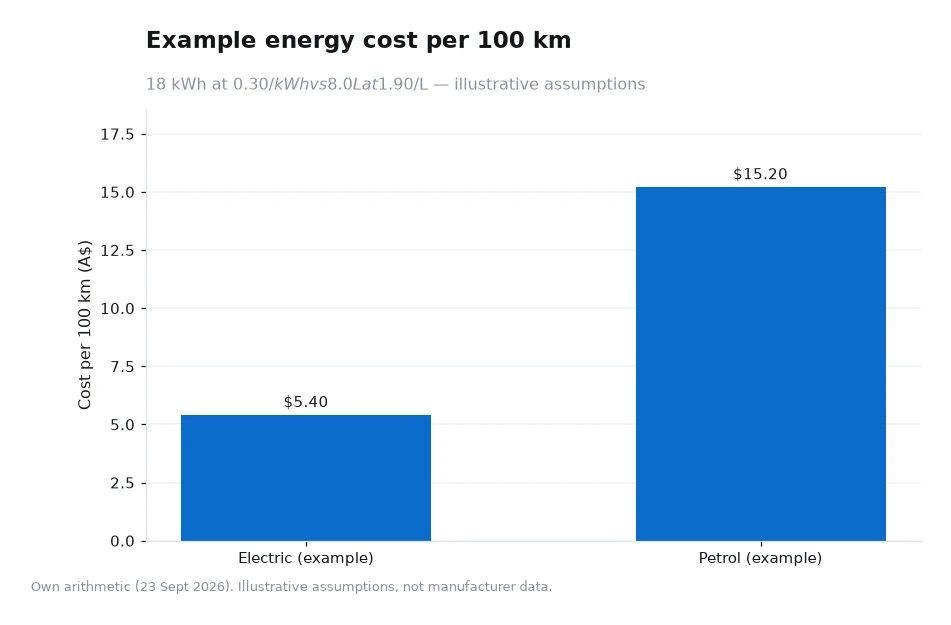
Safety equipment changes what happens in a crash; the cost of running the car is a separate question, and this illustrative example matches the chart below. Assumptions: 18 kWh per 100 km at $0.30 per kWh for electric running, and 8.0 L per 100 km at $1.90 per litre for a petrol comparison. Electric: 18 x 0.30 = $5.40 per 100 km. Petrol: 8.0 x 1.90 = $15.20 per 100 km. The difference is 15.20 - 5.40 = $9.80 per 100 km. Over an assumed 15,000 km a year that is 150 blocks of 100 km, so 150 x 5.40 = $810 against 150 x 15.20 = $2,280, a gap of $1,470 across the year. Every input here is an assumption rather than a published figure; change the consumption or the tariff and the answer moves with it.
Frequently asked questions
Does a five-star rating mean the car cannot be written off in a crash?
No. A five-star result reflects how the vehicle performed against a standardised test protocol, including structural performance and safety-assist scoring. It is comparative evidence, not a guarantee, and outcomes in a real incident depend on speed, angle, load and the other vehicle involved.
Is XPILOT ASSIST a self-driving system?
It is not. The published footnote describes it as an assistance function: the driver must remain aware, monitor traffic and take over when needed, and the system does not remove the driver's responsibility. Treat it as help for the tedious parts of a drive rather than as a substitute for attention.
Sanity checks before your test drive
Ask the dealer which safety features are standard on the variant you are pricing rather than on the range as a whole, since availability varies by configuration across the line-up. Then check the things a rating cannot police: tyre pressures and tread, whether a child restraint anchors cleanly in the position you will use, and whether you can see out of every window from the driving position you actually adopt. None of those are glamorous, and all of them change your odds more than one extra point on a test score. If a question is not answered on the model page, the manufacturer's published FAQ is the next place to look before a forum, and the Australian range overview is the quickest way to see what else sits beside this car.
The rating framing, system names and perception figures quoted here come from the manufacturer's Australian pages as read on 23 Sept 2026, and the driving-assistance footnote is the manufacturer's own wording in substance. The cost table in the worked example is my illustrative arithmetic, not manufacturer data. WLTP figures and assist performance depend on conditions. [1]