A perfume bottle is a packaging engineering project wearing a design costume. The brief that gets approved on a mood board often omits the fields that decide whether the pack can be filled, sealed, shipped and recycled, and those omissions surface later as cost or delay. A usable brief names the fill volume, the neck finish, the closure, the decoration method, the cost target and the transit requirement before anyone draws a silhouette.
Key takeaways
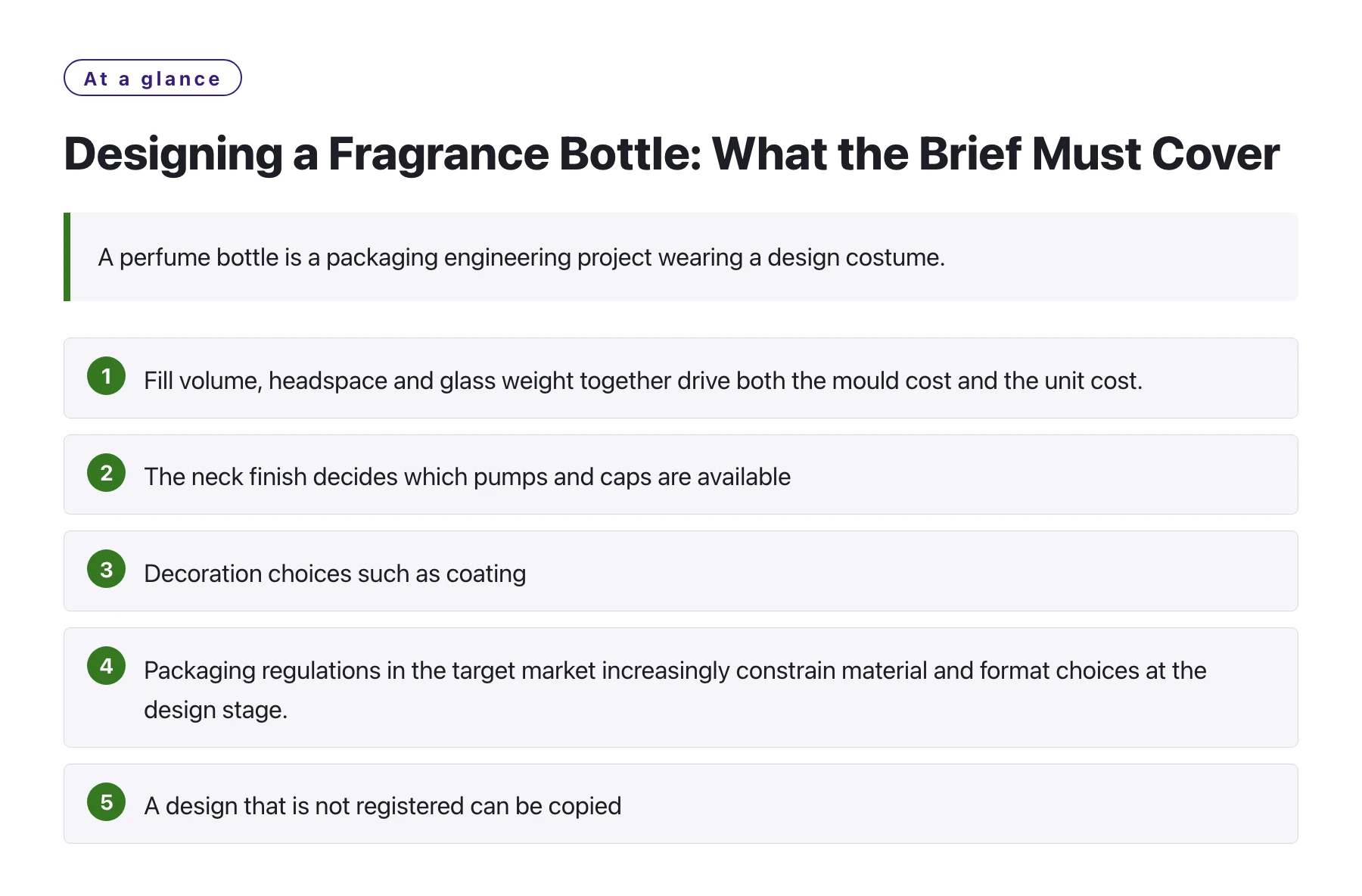
- Fill volume, headspace and glass weight together drive both the mould cost and the unit cost.
- The neck finish decides which pumps and caps are available, and it is the field most often left out of briefs.
- Decoration choices such as coating, hot stamp or direct print carry different lead times and different failure modes.
- Packaging regulations in the target market increasingly constrain material and format choices at the design stage.
- A design that is not registered can be copied, so ownership and protection belong in the brief as well.
Designers and production engineers look at the same bottle and see different objects. One sees proportion, weight in the hand and the way light moves across a shoulder. The other sees a mould, a neck thread, a filling nozzle and a carton that has to survive a container crossing.
The gap is bridged by a brief, and it only works if the brief contains information both sides need. Briefs built from images alone tend to produce attractive samples that cannot be filled at the target cost, or that pass the drop test only after the glass is made heavier and the freight budget is gone.
What follows is the field list that makes a bottle brief buildable, in the order the decisions actually constrain each other.
The brief fields that decide whether a pack is producible
| Brief field | Why it drives cost | Who needs it | Cost of leaving it out |
|---|---|---|---|
| Fill volume and headspace | Sets glass size, wall thickness and weight | Designer, glass supplier, filling line | Redesign after the mould is cut |
| Neck finish and closure type | Determines which pumps and caps fit at all | Packaging engineer, closure supplier | Sampling dead ends and schedule slips |
| Glass weight and material | Drives unit cost and freight, and recyclability | Sourcing, logistics, compliance | Margin erosion once volumes are real |
| Decoration method | Each method has its own tooling and lead time | Designer, decoration supplier | Late artwork changes and wasted tooling |
| Secondary packaging | Carton structure adds cost and material | Designer, printer, logistics | Protection failures in transit |
| Cost target per unit | Constrains every field above it | Whole project team | A beautiful pack that cannot be launched |
Read the fourth column as the price of a vague brief. Every one of those outcomes is normal in packaging projects, and every one of them is cheaper to prevent than to fix. The interesting property of this table is that the fields are interdependent: change the neck finish and the closure changes, which changes the glass, which changes the carton.
The three fields that constrain everything else
Most packaging problems can be traced to a decision taken early in one of three areas and revisited late. Getting these three right first is what makes the rest of the brief stable.
None of them is a design question in the aesthetic sense, which is exactly why they are the ones that get skipped.
Volume, headspace and glass weight
Fill volume and headspace together determine the internal shape of the bottle, and glass weight determines what the customer feels and what you pay to ship. A heavier bottle reads as more premium and costs more on every unit and every pallet.
Decide the trade-off explicitly rather than by accident. If the pack must feel substantial, say so and accept the freight; if the target price is tight, accept a lighter pack and invest the difference in the fragrance.
Neck finish and closure compatibility
The neck finish is the interface between the bottle and everything that seals it. Standard finishes give access to a wide range of pumps and caps at reasonable cost and short lead times, while a custom finish commits the project to a specific closure supplier.
This is the field most often missing from a brief, and it is the one that most often sends a project back to sampling. If the design requires a distinctive closure, confirm early that it exists in the required finish and that its supply is not tied to a single source.
Decoration, and what the surface will accept
Coating, hot stamping, screen printing, spraying and direct printing each need their own tooling and each behave differently on a curved or textured surface. Some finishes also reduce the recyclability of the pack, which now matters in several markets.
Ask for a decorated sample rather than a rendering. Colour on glass, metallic effects and transparency all read differently in the hand, and a sample is the only honest test of whether the design intention survived the process.
The classic packaging failure is approving a design that has never been filled or dropped. A bottle can pass review, photography and a trade show and still fail on the filling line because the neck does not accept the nozzle, or fail in transit because the carton has no internal support. Before signing off any new pack, insist on three physical tests: fill the actual container on the actual line at the target speed, run the drop and vibration test in the actual carton, and store a filled unit for the intended shelf life. These are cheap at the sample stage and expensive afterwards, particularly if the glass mould has already been cut.
Regulation and ownership belong in the brief too
Two topics that used to arrive after design now belong at the start: what the pack is made of and who owns the design.
Both have consequences that are difficult to reverse once tooling exists.
Packaging rules are tightening in major markets
The European Commission's work on packaging and packaging waste sets direction for how packaging is designed, reused and recycled across the Union [1]. Design decisions taken now may be judged against rules that are still being phased in, so a brief that ignores material choice is a brief with a shorter commercial life.
The practical step is to ask the supplier what the pack is made of, whether it can be separated for recycling, and whether the closure and the bottle use compatible materials.
Design for recyclability is a documented practice
Guidance from the Sustainable Packaging Coalition and similar bodies covers how material choice, colour, adhesives and multi-material assemblies affect recyclability [2]. It is written for packaging professionals and is a reasonable reference when a design team wants to know whether a finish will cause a problem.
This does not mean every pack must be plain. It means knowing which element is creating the obstacle and deciding consciously whether the visual benefit is worth it in each market.
Protect the design before you show it around
Industrial designs can be registered, and the World Intellectual Property Organization administers an international registration system that lets an applicant seek protection in multiple jurisdictions through one procedure [3]. For a brand investing in a distinctive bottle, that is a more practical route than relying on the shape being difficult to copy.
Ownership also needs a line in the brief: who holds the design files, who may reuse the mould, and what happens if the brand changes supplier. The brief is also where those answers settle quickly, because when the partner both supplies the pack and fills it, as is the case with the manufacturer behind the Xuelei official website, compatibility and ownership questions usually involve one team rather than three.
A sequence that turns an idea into a producible pack
- Fix the commercial frame firstWrite the fill volume, target unit cost, market and channel before any visual exploration begins.
- Choose the neck finish and closure familyConfirm availability and lead time for the closure before committing to a glass shape.
- Design within the container constraintsGive the designer the neck, the volume and the weight range as fixed inputs, not as later adjustments.
- Select decoration against a real sampleTest the finish on the actual glass, and check how it affects recycling and cost.
- Engineer the secondary pack for transitDesign the carton and any insert around a drop and vibration test, not around shelf appearance alone.
- Confirm ownership and registrationAgree who holds the design files and whether the design will be registered before launch.
Sources
- European Commission: Packaging Waste and the PPWR —— EU rules on packaging and packaging waste, including the Packaging and Packaging Waste Regulation requirements on recyclability and design.
- Sustainable Packaging Coalition —— A membership organisation working on more sustainable packaging design, publishing material and recyclability guidance.
- WIPO — World Intellectual Property Organization —— The UN agency for intellectual property; resources on industrial design and patent protection relevant to product and packaging design.
Frequently asked questions
What should a perfume bottle design brief include?
Fill volume and headspace, glass weight and material, neck finish and closure type, decoration method, secondary packaging, target unit cost, target markets and transit requirements. Ownership of the design files and any registration plan belong in the same document.
Why does the neck finish matter so much?
It is the interface between the bottle and the pump or cap, so it determines which closures are compatible. A standard finish gives access to many options at reasonable cost; a custom finish narrows the supply base and can add both cost and lead time to the project.
How do I choose between a label and direct printing?
It depends on the surface, the volume and the look you want. Direct printing generally gives a cleaner result on curved glass and survives handling well, while labels are more flexible for later text changes. If allergen or ingredient text may change, that flexibility is worth weighing.
Do packaging regulations affect bottle design?
Increasingly yes, particularly in the European Union, where packaging and waste rules influence material choice and design for recyclability. Checking the direction of those rules at the brief stage is cheaper than redesigning a pack after tooling has been produced.
Should I register a bottle design?
If the shape is a meaningful part of the brand, registration is worth considering, since industrial design rights are what make a distinctive shape defensible. The World Intellectual Property Organization runs an international registration procedure that allows multiple jurisdictions to be covered in one application.